Design Systems That Penalize Manual Overrides
The question is why “one-off” exceptions so often turn a stable process into a cleanup exercise. What’s at stake isn’t just a slightly uglier email or a missing field. It’s trust in the workflow: once operators learn that touching the system can silently corrupt outputs, they start working around it, and the system becomes optional.
From first principles, operations systems exist to produce consistent outcomes under real conditions—not ideal ones. Real conditions include exceptions, partial data, timing issues, and human judgment. When we design only for straight-through processing, we implicitly treat manual intervention as “outside the process.” That’s when the system stops protecting the integrity of the transaction and starts emitting plausible-looking artifacts that are wrong.
What makes this failure mode dangerous is that it often fails quietly. A remittance message changes format. An invoice number drops out. A document becomes a generic PDF with reduced detail. Nothing crashes. The record “sends.” The error is discovered later by a vendor, a controller, or an analyst reconciling mismatches—when it’s most expensive to fix.
Why Manual Overrides Break “Happy Path” Systems
Most workflow automation is built around the 95% case: standardized data, predictable routing, and templated output. Success gets measured as volume that requires no touch. That metric is useful, but it creates a blind spot: the remaining 5% are not random. They are the cases where risk, nuance, or external constraints show up—exactly where the system should be strongest.
The failure is usually structural:
- Different execution paths: the moment a user edits a message, attaches a file, changes a field, or re-routes approval, the system takes a different internal path—often one that wasn’t tested with the same rigor.
- Template fallbacks: manual edits can force a fallback template that has fewer tokens, different merge logic, or weaker validations. “Invoice #” becomes “bill.” Embedded HTML becomes a generic attachment.
- Data model mismatch: the automated path may rely on fields that are guaranteed by upstream automation (like a populated reference number). The manual path might bypass that guardrail, so downstream steps receive incomplete data.
- Silent degradation: rather than blocking the action, the system degrades output quality and continues, producing something that looks acceptable until it’s used.
This isn’t a “user error” problem. Operators are responding to real-world requirements: “add this instruction,” “use this subject line,” “include this detail,” “send to this alternate contact.” The design flaw is that the system treats those requirements as unstructured input, not as a first-class part of the process.
A Better Principle: Overrides Must Be Deliberate, Visible, and Costly
The core design inversion is simple: manual overrides should never be cheap and silent. They should be expensive (in time or friction), visible (auditable and measurable), and deliberate (a distinct workflow with explicit consequences).
“Expensive” doesn’t mean punitive in a cultural sense. It means the system introduces enough friction that people don’t casually bypass standards. The standard path remains fast. The exception path remains possible, but it requires intent and accountability.
Fork the Workflow the Moment a User Deviates
Consider a common case in ERP-driven finance operations: an operator wants to customize a remittance email for a vendor payment. In many systems, clicking “edit message” subtly changes the rendering or attachment behavior. That’s how you get a missing invoice number or a degraded format.
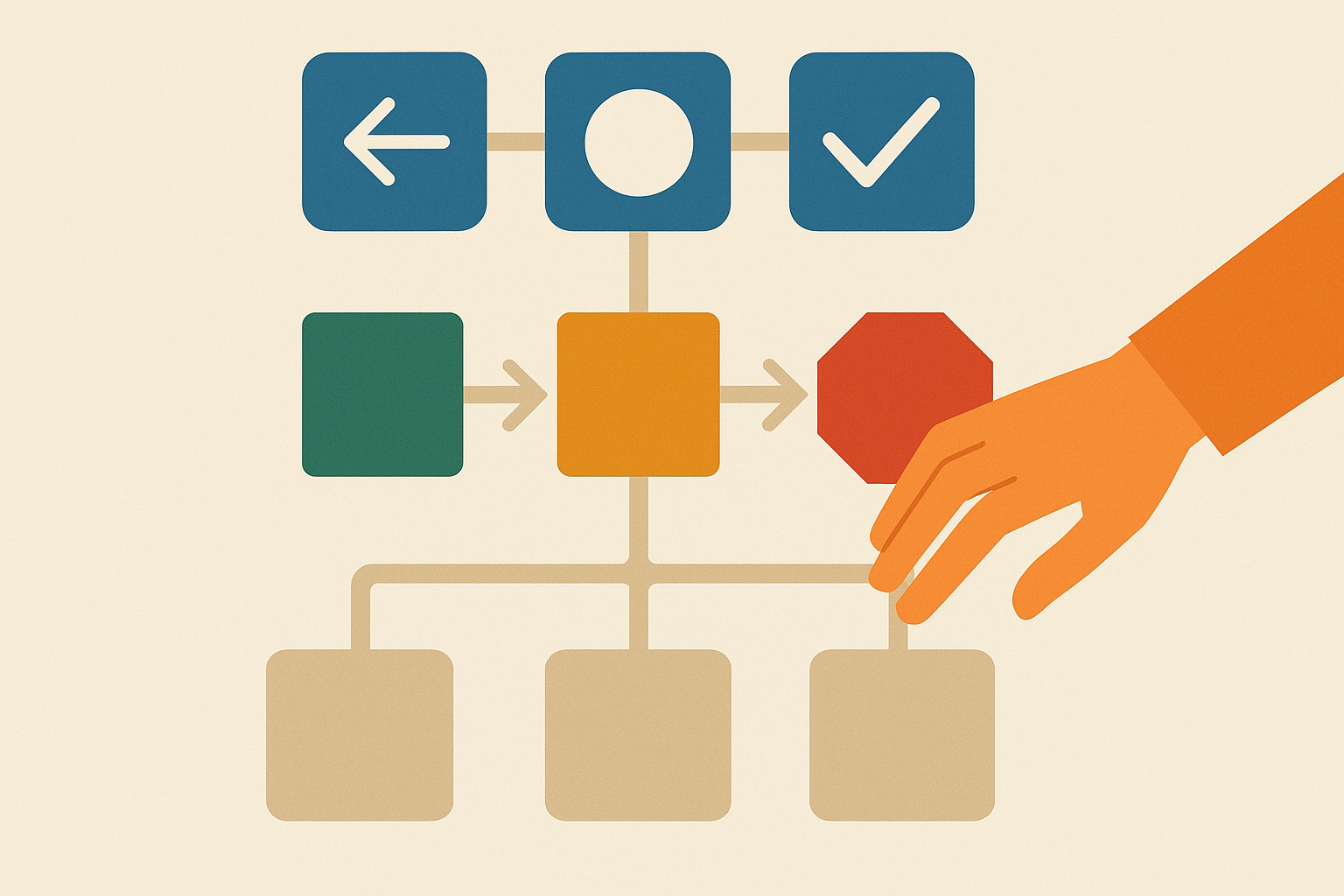
Instead, the system should fork the process. The moment a user attempts a manual edit, the system should move them into an “exception mode” with explicit semantics:
- Clear warning: “You are creating a custom remittance. Standard formatting may change. This will require review before sending.”
- Different output contract: the system commits to a known-safe output type for exceptions (for example, a PDF generated from a controlled template that always includes invoice references).
- Explicit review step: the operator must preview the exact artifact that will be sent.
- Explicit approval or acknowledgment: for higher-risk transactions, require a second set of eyes or a logged acknowledgment.
The key is that the exception path is designed, not accidental. The system doesn’t “try its best” and hope. It switches into a workflow that protects data integrity.
Make the Cost of Exceptions Measurable
Once exceptions become a distinct path, you can measure them. That matters because many organizations can’t improve what they can’t see. Track:
- Override frequency by transaction type and team
- Most common override reasons (captured via a short required reason code)
- Downstream defect rates tied to overrides (vendor disputes, re-sends, reconciliation issues)
- Cycle time impact of exceptions
This turns overrides into a diagnostic signal. If 20% of remittances require custom notes, the solution probably isn’t “tell people to stop.” The solution is to incorporate structured fields or rule-based variants into the standard process.
Design Methods That Prevent Silent Corruption
Define Output Contracts and Validate Them
Every automated communication or document should have a contract: required fields, required identifiers, and invariants. For remittances, that might include “must contain payment reference,” “must list invoice numbers,” and “must identify vendor and bank account mask.”
Then validate the artifact before it can be sent. If an override path results in an output missing required identifiers, block the send with a precise error: “Invoice reference missing; choose a template that includes invoice detail or add invoice references explicitly.”
This is a better user experience than sending a broken email and creating a multi-step recovery.
Prefer Structured Overrides Over Free-Form Edits
Free-form text boxes are where integrity goes to die. When possible, replace “edit message” with structured options:
- Pre-approved message variants (“ACH update,” “partial payment,” “credit memo applied”)
- Optional structured fields (“special instruction,” “attention line,” “project code”)
- Rule-based conditional inserts (“if vendor requires PO, include PO list”)
Operators still get flexibility, but the system keeps control of critical identifiers and layout. This is especially relevant in NetSuite and similar ERPs, where small changes in templates or scripts can push the system into alternate renderers.
Introduce a “Safe Preview” as a Hard Gate
If the system can’t guarantee correctness in an override path, require preview. Not as a convenience feature, but as a gate. Show exactly what will be sent, including attachments, formatting, and all merge fields resolved. The operator must confirm.
In practice, this reduces vendor-facing defects dramatically because it catches the common failure: the message “looked right” in an editor, but the generated output lost content.
Example: Remittance Emails in an ERP Automation Context
In a typical ERP workflow, payment execution triggers remittance generation. The happy path uses a standard template, populated by transaction and vendor fields. The exception occurs when an operator needs to add a one-time note. In many implementations, the edit causes the system to fall back to a generic remittance template, often with reduced merge tokens and different attachment logic.
A resilient design makes the fork explicit:
- Standard Send: one click; embedded HTML; guaranteed inclusion of invoice list; no edits.
- Custom Send: requires reason code; switches to controlled PDF; forces preview; logs who changed what; optionally requires approval above a threshold.
The operator isn’t punished with cleanup. They’re guided into a workflow that is intentionally more expensive, because it’s inherently riskier. The system protects the organization’s output quality while still supporting real-world needs.
Conclusion
Ultimately, a system that breaks when a human touches it isn’t automated; it’s brittle. The question is why we tolerate brittleness in the exact moments when judgment and exceptions appear. Those moments are not edge cases operationally—they’re where errors become external and costly.
What this means in practice is designing manual overrides as first-class workflows. Make them deliberate, visible, and measurably expensive. Fork the process on deviation, validate output contracts, require safe previews, and prefer structured variation over free-form edits.
The takeaway is straightforward: don’t let exceptions silently degrade the artifact. If a process must be overridden, the system should acknowledge it, constrain it, and record it—so operators can do their job without turning every “one-off” into a hidden defect.