Your System Isn't Broken. It's Incomplete.
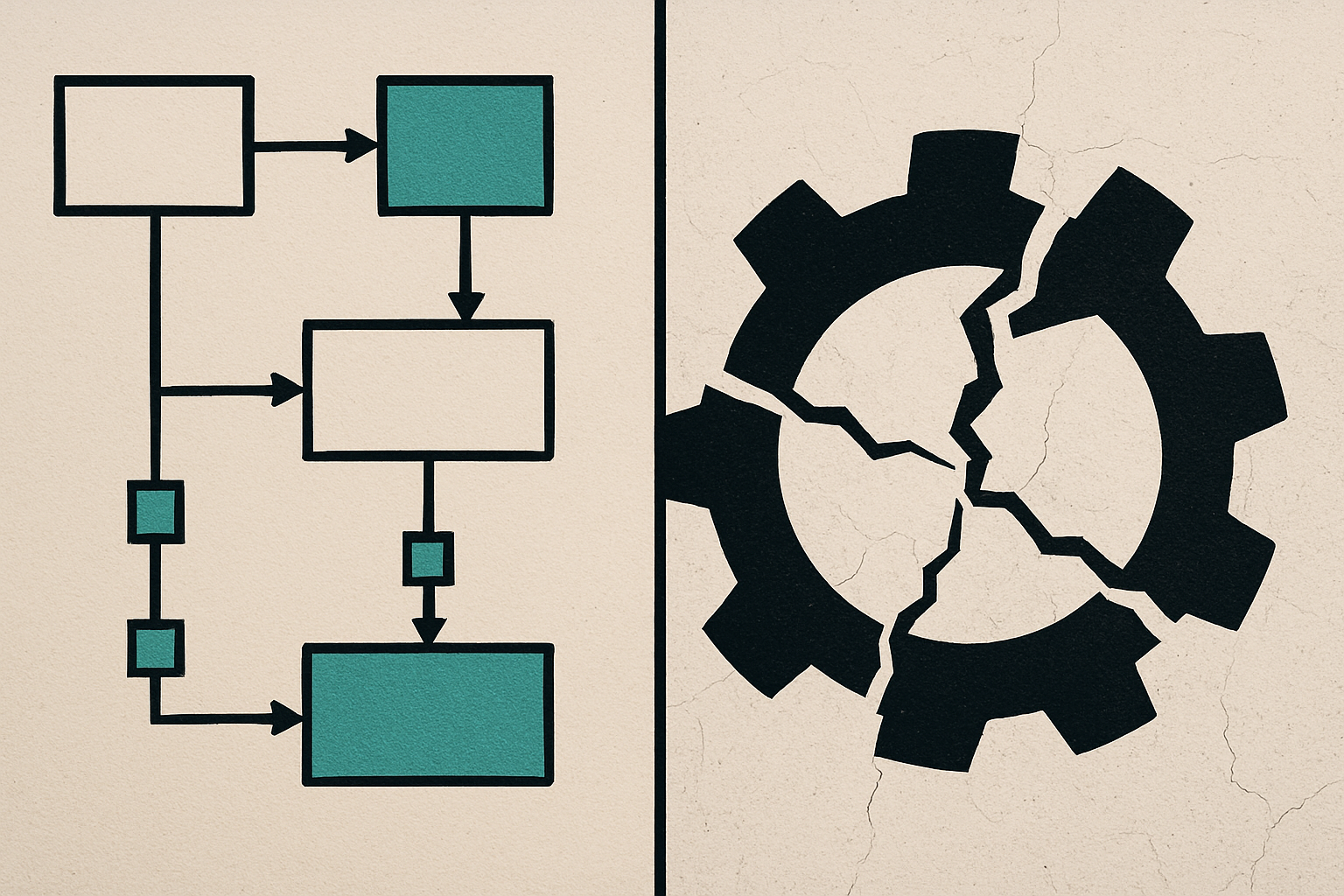
The question is why so many operational “failures” look like defects, when they’re usually design gaps. A report doesn’t run. An integration rejects a record. A required field is missing. The reflex is to search for what changed: a permission, a form layout, a script deployment. What’s at stake isn’t just uptime; it’s whether your system can reliably carry the process without depending on memory and heroics.
From first principles, a business system is not a screen and a set of fields. It is a container for decisions: what should happen, when, with what exceptions, and with what evidence. When the system can’t make a decision, we frequently patch over the gap by making it “a user task.” That’s not a fix. It’s a debt instrument.
Most teams don’t have broken systems. They have incomplete ones: systems that execute transactions but don’t consistently carry the context, logic, and guardrails needed to produce clean outputs at scale.
The myth of the “user task”
When automation stops short, the common compromise is manual capture: “Have the user pick the compliance code.” “Add a checkbox for the region.” “Tell AR to populate the integration field.” The request is usually framed as small: one more field, one more step, one more reminder.
But each manual step is the system asking a person to become an extension of its logic. The user is trying to complete their immediate work—create an invoice, post a bill, fulfill an order. The system quietly asks them to also be a data steward, a policy expert, and a controller of downstream outcomes. That burden compounds across departments until the process becomes a chain of invisible requirements.
What manual steps really introduce
- Ambiguity: The “right” value depends on scenario interpretation, and scenarios multiply.
- Inconsistency: Two people in good faith choose two different values.
- Latency: Corrections happen later, often after month-end pressure makes them harder.
- Fragility: The process works only when the user’s context matches the designer’s assumptions.
If the process fails, it looks like user error. In reality, it’s a design decision: the system was never finished.
You can’t train your way out of a design flaw
Training is valuable when the work genuinely requires judgment. Training is not a substitute for system logic. If the workflow’s correctness depends on someone remembering a special case at the point of entry, you have built a failure mode into the process.
Even strong teams can’t sustain perfect compliance with dozens of micro-rules. Staff turnover happens. Work volume spikes. Priorities shift. And the incentives are misaligned: users are measured on throughput, not on the long-tail quality of metadata that only becomes visible in downstream reporting or integration.
When the inevitable miss occurs, the organization often repeats the same pattern: send a reminder, update the SOP, retrain. The underlying problem remains: the system has no mechanism to reliably determine what should be true.
The core principle: a system should know itself
A well-designed ERP environment should not require a user to tell it what it already knows or can derive. Context should be inherited, and attributes should be computed where possible. This is less about “automation” and more about definitional clarity: where does truth live, and how does it propagate?
In NetSuite terms, the system already carries rich context:
- Org structure: subsidiary, location, department, class
- Customer and vendor attributes: tax registration, terms, currency, region
- Item and service attributes: revenue rules, tax schedule, recognition behavior
- Transaction intent: type, status, posting period, workflow state
When teams add new fields that restate this context (or ask users to interpret it), they create parallel truths. Parallel truths drift. Drift becomes reconciliation work. Reconciliation becomes “how we do things here.”
From manual entry to inherited context
Consider a common compliance example: invoices connected to a Spanish subsidiary require a specific reporting classification. The typical implementation is a dropdown on the invoice: Compliance Category. The user must remember to set it correctly on every transaction.
The alternative is to derive it. The system already has the invoice subsidiary, the customer’s jurisdiction and tax setup, and the transaction type and posting behavior. So the classification can be set automatically via a rule: on creation or before submit, evaluate subsidiary + jurisdiction and set the compliance flag. The field does not need to be visible. It may not even need to be editable.
Design pattern: derive, don’t request
- Prefer computed defaults: Set values based on record context at create-time.
- Lock what should be deterministic: If a value is a rule outcome, don’t let it drift via ad hoc edits.
- Record the reasoning: If audit matters, store “derived by rule X on date Y” or keep a lightweight log.
This is not about removing humans from the process. It’s about removing humans from acting as glue between data points that the system can already connect.
Completeness as a design test
When a team encounters a recurring exception, the key question isn’t “where do we add a field?” It’s “what decision is the system failing to make, and what inputs does that decision require?”
A practical method: the decision inventory
For any fragile workflow (order-to-cash, procure-to-pay, revenue, close), list the decisions that must be correct for downstream outcomes to be correct. Then, for each decision:
- Inputs: What fields or master data drive it?
- Source of truth: Where should those inputs live?
- Derivation point: When should the value be computed (create, edit, approval, posting)?
- Enforcement: How do we prevent bypass (permissions, workflows, validation, locked fields)?
Example: integration failures that “look random”
An integration failing on “missing external ID” often triggers a search for a hidden field or a script that stopped running. Often, the deeper issue is that the external ID is a required routing attribute but has no deterministic source. One team expects users to populate it; another expects the integration to generate it; a third expects it to be inherited from the customer record.
A complete design makes the choice explicit: define the source of truth, generate it once, and make it non-optional through validation. Then the integration is no longer “fragile.” It’s simply strict.
Where to be careful: not everything should be derived
Some fields represent real-world intent or judgment: a promise date negotiated with a customer, a write-off reason, an exception approval. Trying to derive these creates false certainty. The goal is not to eliminate human input; it is to eliminate human re-entry of context the system already has.
A good test is: if two qualified people have the same inputs, should they always choose the same value? If yes, it’s a rule. If no, it’s a decision—and the system should structure it, not guess it.
Conclusion
The question is why operational teams keep treating gaps like defects. It’s because the failure shows up at the surface: a missing field, a rejected record, a report that doesn’t tie out. But what’s at stake is whether your ERP is merely recording activity or actually carrying the process end-to-end.
Ultimately, the most resilient systems are the ones that know themselves: they inherit context, they compute what can be computed, and they force explicit decisions only where judgment is truly required. That’s not extra sophistication; it’s completeness.
What this means in practice is straightforward: each time you’re tempted to add a manual step, pause and ask whether the system already has the information needed to decide. If it does, build the logic. If it doesn’t, fix the upstream data model and flow. The takeaway is simple: your system isn’t broken. It’s incomplete—finish the design.